
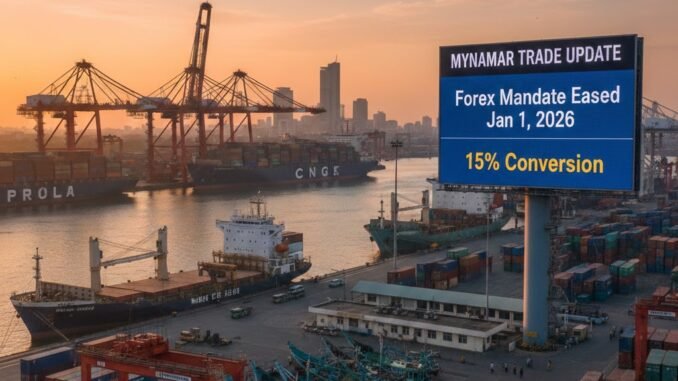
YANGON – As Myanmar moves into the early months of 2026, the nation’s trade landscape is being defined by a significant easing of foreign exchange controls and a steady, if strained, performance in agricultural and fishery exports. Despite the ongoing complexities of the domestic environment, recent data suggests a strategic push to stabilize the economy through export-driven revenue.
Central Bank Relaxes Forex Mandates
The most pivotal development in this period occurred on January 1, 2026, when the Central Bank of Myanmar (CBM) issued Notification 2/2026. This policy significantly reduced the mandatory foreign currency conversion requirement for exporters.
- The Shift: Exporters are now required to convert only 15% of their earnings into Myanmar Kyat at the official reference rate ($2,100$ Kyat/USD), down from the previous 25%.
- The Impact: The remaining 85% can now be traded at market-driven online rates (approximately $3,650$ Kyat/USD).
- Goal: This move is widely seen as an attempt to incentivize legal trade channels and curb the growing informal “hundi” market.
Export Highlights: Agriculture and Fisheries
Agricultural products remain the backbone of Myanmar’s trade, with several sectors showing notable resilience through the 2025–2026 fiscal year:
| Sector | Performance (Apr 2025 – Dec 2025) | Key Markets |
| Fisheries | Over $278.9 million earned; 227,000+ metric tonnes exported. | China, Thailand, Japan |
| Rice | Target of 3 million tonnes for the full fiscal year. | Indonesia, China, Belgium |
| Maize | Over $400 million in export value recorded so far. | Regional partners |
| Rubber | Aims to reach 350,000 tonnes by March 2026. | China (75% of total) |
Trade Partners and Port Activity
China and Thailand continue to dominate as Myanmar’s primary trading partners, particularly for natural gas and pulses. However, trade with the West remains limited.
- UK Trade: Recent reports indicate total trade with the UK reached approximately £404 million by late 2025, a slight year-on-year decrease.
- Logistics: Yangon ports maintained steady activity, with over 50 container vessels arriving monthly through the end of February 2026 to facilitate maritime trade, which remains more robust than border trade due to regional instabilities.
Looking Ahead
While the relaxation of currency rules provides a “breather” for the private sector, the economy faces headwinds from high inflation—projected at 23% for 2026—and logistics disruptions. The focus for the remainder of the year will likely stay on import substitution for fuel and medicine to preserve the foreign reserves gained from these early 2026 export successes.